




Cricket World Cup Live Audio Video

Broadcast from 2007 March 13 to April 28
Cricket World Cup on TV, Internet and Mobile Phones
The ICC Cricket World Cup All Inclusive Package $199.95World Cup Cricket Live on TV: Live Broadcasting
TV : All Live Matches, Full Replays, Highlights, Interactive TV Application - Get Dish + Full World Cup Cricket PackageWorld Cup Cricket on Internet: Live Streaming
Internet: Full coverage (limited to one Internet Address), Interactive Highlights, Live audio - Get Dish + Full World Cup Cricket PackageWorld Cup Cricket on Mobile: Live Audio
Mobile: Ball-by-Ball coverage on your mobile phone, Discounted access to unlimited SMS updates - Get Dish + Full World Cup Cricket PackageWills World Cup Cricket 1996, India, Pakistan & Sri Lanka
Video - Re-live the highlights from the 1996 World Cup with this selection of 100 catches - from almost all the games in the world cup....featuring Sri Lanka, India, Pakistan, Australia, England, New Zealand, West Indies and South Africa. Some of the catches are classics, whilst others are pretty ordinary.
Dates: 16 February 1996 to 17 March 1996
Teams: West Indies, England,India, Pakistan, Australia,
New Zealand, Sri Lanka, Zimbabwe, Kenya, Netherlands,
South Africa & United Arab Emirates
ICC Cricket World Cup
World championship of men's One Day International cricket
World Cup Cricket history, champions | World Cup Cricket facts, trivia | World Cup Cricket records before 2007 | 2007 World Cup Cricket records | World Cup Cricket 1975 | World Cup Cricket 1979 | World Cup Cricket 1983 | World Cup Cricket 1987 | World Cup Cricket 1992 | World Cup Cricket 1996 | World Cup Cricket 1999 | World Cup Cricket 2003 | World Cup Cricket 2007 | World Cup Cricket 2011 | World Cup Cricket 2015 | World Cup Cricket 2019World Cup Cricket 1996
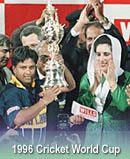
Sri Lanka Won the World Cup
There were some good, uplifting aspects to the sixth cricket World Cup, not least the style and smiles of its unsuspected winners, Sri Lanka, but overall this was not a tournament to linger fondly in the memory. Wounded by events beyond its control even before its opening, the competition proceeded to frustrate and bewilder through an interminable and largely irrelevant saga of group games in India, Pakistan and Sri Lanka before hastening frantically through its knockout games in little more than a week.The event was poorly conceived in its format and its logistics and suffered throughout from the threat – and ultimately the reality – of crowd disorder. The abandonment of the semi-final at Eden Gardens, Calcutta, following bottle-throwing and fire-lighting on the terraces, was a shameful reflection on standards of sportsmanship in an area until recently renowned for its appreciation of all things good in the game of cricket.
Perhaps, however, we should not be too harsh on the individuals responsible for the riot in Calcutta. They were merely responding to the seductions created for them by the promoters of the Wills World Cup, an event that plainly, disastrously, put money-making above all the fundamentals of organising a global sporting competition. As the glamorising of the Indian and Pakistani cricketers reached new and absurd heights, so too did the unshakeable belief of the masses in their invincibility. Defeat, of the kind that came to India that night in Calcutta, was popularly unimaginable, with consequences for which many must share the blame.
It was all markedly at odds with the 1987 World Cup, also co-hosted by India and Pakistan and widely judged to be an organisational triumph. Players and observers alike enjoyed that competition far more than the 1996 event. Yet the paradox is that, when the accounts were complete, they showed a negligible profit. Within a decade, the profile of the game had altered substantially; so too, it transpired, had the methods and ambitions of those charged with running the tournament. Suddenly, it was deemed more important to register a company as supplier of official chewing gum – and take its money – than to pay proper attention to the welfare of the competing teams. Of course, it is possible to become too nannyish about professional sportsmen, who by and large lead a pretty pampered existence, but the wearisome travel schedules, illogical playing itineraries and inadequate practice facilities inflicted on most of the visiting teams would have caused a serious rebellion had this been a football championship.
In fact, such elementary flaws should have been dealt with at source, long before they became a millstone around the event. The reason they were not – the handing over by the International Cricket Council of all responsibility for the tournament to the World Cup committee, Pilcom – reflects poorly on all those responsible. What function does ICC perform if it is not to be a vigilant monitor of events like this? Cricket must never permit such complacency again.
ICC must also take the blame for the format. The expansion of the field to 12, from nine in 1992, was quite right. By embracing three of ICC’s Associate Members, the non-Test countries, the World Cup was fulfilling its missionary aim (though whether the Associates, wooed by financial guarantees, had too much say in the venue is another serious matter for ICC to consider). The problem arose when the extra teams were accommodated by a complete change from the successful 1992 system, a round-robin producing four semi-finalists. Instead, the teams were divided into two groups of six, from which not four but eight sides would proceed to the knockout rounds. The effect of this, obvious in advance, was to reduce virtually a month of cricket to the status of little more than practice games: duly, almost inevitably, the three Associate nations and the junior Test-playing team, Zimbabwe, were eliminated.
All this could have been avoided, and a genuinely competitive group programme installed, by discarding the idea of quarter-finals and going straight to a last four. Presumably, the attraction of four big crowds, four big television games, was too great, but this was a decision taken on flawed grounds. The people were not all fooled; the group games in Pakistan, particularly, drew very small crowds.
The logistical chaos of the competition stemmed largely from the decision, laudable in theory but utterly unrealistic, to spread the tournament to virtually every corner of the vast country of India. The 17 games scheduled for the country were all staged in different cities and insufficient attention had been paid to the practicalities of moving teams (let alone television crews and media people) between games. Travel in India is problematical at best; a few specific alterations were made to airline schedules to oblige the competition organisers but nowhere near enough to surmount the problem, the size of which became clear during the first, eventful weekend. The teams were all due to gather in Calcutta for a variety of briefing meetings before the much-vaunted opening ceremony, a celebration of technology for which the organisers had outlaid considerable capital.
As it transpired, however, the weekend was dominated by the issue of two teams, Australia and West Indies, adamantly refusing to play their scheduled group games in Colombo. The bomb blast in the city, a fortnight earlier, was the clinching factor, but Australia’s players were already uncomfortable about visiting Sri Lanka, with whom they had just played an acrimonious Test series. In truth, they were reluctant to participate in the Cup at all, the backwash of their bribery allegations against Salim Malik having brought threats of an unpleasant nature from a number of fanatics around Pakistan. West Indies had far less reason for prudence on the Colombo issue, but the condemnatory tone of the organisers against the two defectors gave the episode an unwarranted tone, intensified by a press conference that touched heights of incoherent rancour. It was even suggested that Australia and West Indies were indulging in a vendetta against the Third World, until it was gently pointed out, by ICC’s chairman, Sir Clyde Walcott, that the Caribbean forms part of the Third World.
Positions being entrenched, the matches were forfeited, though it was a commentary on the cosiness of the format that Australia and West Indies could make such a sacrifice without seriously endangering their progress to the business end of the tournament. Sri Lanka were both winners and losers – winners because they received four points, and a comfortable passage to the last eight, without playing, but losers because their lovely island was deprived of its two biggest matches at a time when the public was most in need of rousing diversions. For them, however, the grandest of compensations awaited.
The opening ceremony was attended by more than 100,000 people, most of whom must have left wondering what on earth they had been watching. The laser show malfunctioned, the compère was embarrassing and the grand launch was a complete flop – so much so that there were subsequent calls at Calcuttan government level for the arrest of the Pilcom convenor, Jagmohan Dalmiya, on a charge of wasting public money.
At 4 a.m. the following morning, four teams gathered blearily in the lobby of Calcutta’s Oberoi hotel. They were all slated for the 6 a.m. flight to Delhi (India’s internal flights tend to run before dawn and after dusk), whereafter they were required to wait many hours before connecting to flights for their various first-game destinations. Had no one thought of organising a charter flight at a civilised hour? Apparently not.
Given this, the choice of the unlovely city of Ahmedabad, and the teams of England and New Zealand, for the opening game of the tournament, should perhaps not seem curious. It was, however, a deflating start, and not just for England, whose obsolete one-day tactics and lack of specific preparation for the only limited-overs event that matters were exposed from the beginning. England were destined to win only two games in the competition, both against non-league opposition, and one of those, against Holland, by an unflatteringly narrow margin. Their players had come to the event tired and unfocused, which was not entirely their fault, but the need for a progressive team manager to replace Raymond Illingworth became ever clearer as their ill-fated campaign continued. England once dictated the terms in one-day cricket; unnoticed by them, other countries have caught up and left them behind, developing new and innovative ways of overcoming the essentially negative restrictions of the overs game.
The use of pinch-hitters was one such method, much discussed and granted more significance than it merited, but it was certainly the case that the successful teams no longer looked to accrue the majority of their runs in the closing overs of their innings. Instead of settling for 60 or 70 runs from the initial 15 overs, when fielding restrictions applied, teams were now looking to pass the 100 mark. On the blissful batting pitches encountered here, it was seldom impossible. Sri Lanka, through their fearless openers, Sanath Jayasuriya – later to be named the Most Valued Player of the Tournament – and Romesh Kaluwitharana, were the trendsetters and, as the outcome proved, nobody did it better. Jayasuriya’s assault on England’s bowling in the quarter-final at Faisalabad was authentic, aggressive batting without insult to the coaching manual.
There were some memorable images from the over-long group stages. Mark Taylor’s sportsmanship, in refusing to claim a slip catch at a pivotal stage against West Indies, was one; the imperious batting of Mark Waugh and Sachin Tendulkar provided more. But the majority involved the minnow nations. The best of them was the catch by Kenya’s portly, bespectacled and none-too-nimble wicket-keeper, Tariq Iqbal, to dismiss Brian Lara. That it led to a Kenyan victory by 73 runs was part of the romance; here was the greatest upset the World Cup has known and, perhaps, a salutary lesson to a West Indies team that had become surly and unattractive. Kenya played their cricket as the West Indians once loved to do, without inhibition; defeat paradoxically restored pride to West Indies. They not only rallied to reach the last eight – roused by 93 not out from their beleaguered captain, Richie Richardson, against Australia – but, there, beat the team that had hitherto looked the slickest in the event, South Africa.
The two main host nations predictably reached the quarter-finals but it was not in the preferred script that they should meet each other so soon. Bangalore had the dubious honour of staging the game and this beautiful, bustling city has never known such an event. The fact that India won it, before an intensely partisan crowd, perhaps averted the kind of disgraceful scenes witnessed four days later in Calcutta, where Sri Lanka utterly outplayed the Indians. In the other semi-final, Australia recovered from an apparently hopeless position to beat West Indies, whose collective nerve crumbled.
Thus was created a meeting, in the final, between two teams who were prevented by politics and expediency from playing each other earlier. Sri Lanka’s victory was to the great approval and acclaim of much of the cricketing world. It was also a result that, to some degree, rescued this World Cup from an abiding image of bungling mediocrity.
The tournament achieved one aim in increasing the profile of cricket, through television coverage on an impressive but largely uncritical scale, and undoubtedly it satisfied the organisers in the amount of money accrued. But the impression was that the cricket was secondary to the commercialism. Even in a game newly awakened to its financial opportunities, that cannot be right.
Cricket World Cup 1996 Finals Score Board
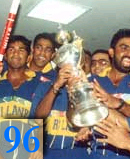
Sri Lanka beat Australia by 7 Wickets
Sri Lanka initiated a watershed in one-day cricket at the 1996 World Cup that took them all the way to an unexpected victory.With Sanath Jayasuriya playing some of the best cricket of his career at the top of the order, their plan was to go on an all out attack in the opening 15 overs and build on that start.
Everything had gone according to plan in the run-up to the final, but come that match it looked as if things may be going awry.
Arjuna Ranatunga won the toss and put Australia in. The previous five finals had all been won by the team batting first.
And with Mark Taylor leading from the front Australia reached 137 for one by the 27th over before attacking fielding and tight bowling stifled Australia's efforts, limiting the favourites to a score of 241.
However, with Sri Lanka's openers back in the pavilion with only 23 runs on the board that target seemed far more foreboding - until Aravinda de Silva got going.
After taking three wickets, he scored an unbeaten century and found able support from Asanka Gurusinha and Ranatunga, the skipper scoring the winning runs to seal a sensational win.
Sri Lanka beat Australia by 7 Wickets
Man of the Match: PA de Silva
Man of the Match: PA de Silva
Sri Lanka won the toss and
decided to Field
|
241 for 7 (50.0 overs) |
|
245 for 3 (46.2 overs) |
| Batsman |
|
Runs |
Balls |
4s |
6s |
|
| MA Taylor | c Jayasuriya | b de Silva | 74 |
83 | 8 | 1 |
| ME Waugh | c Jayasuriya | b Vaas | 12 |
15 | 1 | 0 |
| RT Ponting | b de Silva |
45 |
73 | 2 | 0 | |
| SR Waugh | c de Silva | b Dharmasena | 13 |
25 | 0 | 0 |
| SK Warne | st Kaluwitharana | b Muralitharan | 2 |
5 | 0 | 0 |
| SG Law | c de Silva | 22 | 30 | 0 | 1 | |
| MG Beven | not out | 36 | 49 | 2 | 0 | |
| IA Healy | b de Silva | 2 | 3 | 0 | 0 | |
| PR Reiffel | not out | |
5 |
4 | 0 | 0 |
| Extras | |
1nb 11w 10lb | 22 | |
||
| Total | |
for 7 | 241 | |
||
|
|
Live Cricket

| Batsman |
|
Runs |
Balls |
4s |
6s |
|
| ST Jayasuriya | run out | 9 |
7 | 1 | 0 | |
| RS Kaluwitharana | c Beven | b Fleming |
6 |
13 | 0 | 0 |
| AP Gurusinha | b Reiffel |
65 |
99 | 6 | 1 | |
| PA de Silva | not out | 107 |
124 | 13 | 0 | |
| A Ranatunga | not out | 47 |
37 | 4 | 1 | |
| Extras | |
1nb 5w 1b 4lb | 11 | |
||
| Total | |
for 3 | 245 | |
||
|
|
Live Cricket
Umpires: SA Bucknor (WI) and DR Shepherd (Eng)Australia Team: MA Taylor, ME Waugh, RT Ponting, SR Waugh, SK Warne, SG Law, MG Bevan, IA Healy, PR Reiffel, DW Fleming, GD McGrath.
Sri Lanka Team: ST Jayasuriya, RS Kaluwitharana, AP Gurusinha, PA de Silva, A Ranatunga, HP Tillakaratne, RS Mahanama, HDPK Dharmasena, WPUJC Vaas, GP Wickramasinghe, M Muralitharan.
Summary of results
Group B: England v New Zealand at Ahmedabad - February
14, 1996
New Zealand won by 11 runs. New Zealand 239-6 (50 ov);
England 228-9 (50 ov).
Group A: West Indies v Zimbabwe at Hyderabad - February
16, 1996
West Indies won by 6 wickets. Zimbabwe 151-9 (50 ov);
West Indies 155-4 (29.3 ov).
Group B: South Africa v United Arab Emirates at Rawalpindi
- February 16, 1996
South Africa won by 169 runs. South Africa 321-2 (50 ov);
United Arab Emirates 152-8 (50 ov).
Group A: Sri Lanka v Australia at Colombo - February
17, 1996
Sri Lanka won by a walkover.
Group B: Netherlands v New Zealand at Vadodara - February
17, 1996
New Zealand won by 119 runs. New Zealand 307-8 (50 ov);
Netherlands 188-7 (50 ov).
Group A: India v Kenya at Cuttack - February 18, 1996
India won by 7 wickets. Kenya 199-6 (50 ov); India 203-3
(41.5 ov).
Group B: England v United Arab Emirates at Peshawar -
February 18, 1996
England won by 8 wickets. United Arab Emirates 136 (48.3
ov); England 140-2 (35 ov).
Group B: New Zealand v South Africa at Faisalabad - February
20, 1996
South Africa won by 5 wickets. New Zealand 177-9 (50 ov);
South Africa 178-5 (37.3 ov).
Group A: India v West Indies at Gwalior - February 21,
1996
India won by 5 wickets. West Indies 173 (50 ov); India
174-5 (39.4 ov).
Group A: Sri Lanka v Zimbabwe at Colombo - February 21,
1996
Sri Lanka won by 6 wickets. Zimbabwe 228-6 (50 ov); Sri
Lanka 229-4 (37 ov).
Group B: England v Netherlands at Peshawar - February
22, 1996
England won by 49 runs. England 279-4 (50 ov); Netherlands
230-6 (50 ov).
Group A: Australia v Kenya at Visakhapatnam - February
23, 1996
Australia won by 97 runs. Australia 304-7 (50 ov); Kenya
207-7 (50 ov).
Group B: Pakistan v United Arab Emirates at Gujranwala
- February 24, 1996
Pakistan won by 9 wickets. United Arab Emirates 109-9
(33 ov); Pakistan 112-1 (18 ov).
Group A: Sri Lanka v West Indies at Colombo - February
25, 1996
Sri Lanka won by a walkover.
Group B: England v South Africa at Rawalpindi - February
25, 1996
South Africa won by 78 runs. South Africa 230 (50 ov);
England 152 (44.3 ov).
Group A (replayed): Kenya v Zimbabwe at Patna - February
26, 1996
No result. Zimbabwe 45-3 (15.5 ov).
Group B: Pakistan v Netherlands at Lahore - February
26, 1996
Pakistan won by 8 wickets. Netherlands 145-7 (50 ov);
Pakistan 151-2 (30.4 ov).
Group A: India v Australia at Mumbai - February 27, 1996
Australia won by 16 runs. Australia 258 (50 ov); India
242 (48 ov).
Group A: Kenya v Zimbabwe at Patna - February 27, 1996
Zimbabwe won by 5 wickets. Kenya 134 (49.4 ov); Zimbabwe
137-5 (42.2 ov).
Group B: New Zealand v United Arab Emirates at Faisalabad
- February 27, 1996
New Zealand won by 109 runs. New Zealand 276-8 (47 ov);
United Arab Emirates 167-9 (47 ov).
Group A: Kenya v West Indies at Poona - February 29,
1996
Kenya won by 73 runs. Kenya 166 (49.3 ov); West Indies
93 (35.2 ov).
Group B: Pakistan v South Africa at Karachi - February
29, 1996
South Africa won by 5 wickets. Pakistan 242-6 (50 ov);
South Africa 243-5 (44.2 ov).
Group A: Australia v Zimbabwe at Nagpur - March 1, 1996
Australia won by 8 wickets. Zimbabwe 154 (45.3 ov); Australia
158-2 (36 ov).
Group B: Netherlands v United Arab Emirates at Lahore
- March 1, 1996
United Arab Emirates won by 7 wickets. Netherlands 216-9
(50 ov); United Arab Emirates 220-3 (44.2 ov).
Group A: India v Sri Lanka at Delhi - March 2, 1996
Sri Lanka won by 6 wickets. India 271-3 (50 ov); Sri Lanka
272-4 (48.4 ov).
Group B: Pakistan v England at Karachi - March 3, 1996
Pakistan won by 7 wickets. England 249-9 (50 ov); Pakistan
250-3 (47.4 ov).
Group A: Australia v West Indies at Jaipur - March 4,
1996
West Indies won by 4 wickets. Australia 229-6 (50 ov);
West Indies 232-6 (48.5 ov).
Group B: Netherlands v South Africa at Rawalpindi - March
5, 1996
South Africa won by 160 runs. South Africa 328-3 (50 ov);
Netherlands 168-8 (50 ov).
Group A: India v Zimbabwe at Kanpur - March 6, 1996
India won by 40 runs. India 247-5 (50 ov); Zimbabwe 207
(49.4 ov).
Group A: Sri Lanka v Kenya at Kandy - March 6, 1996
Sri Lanka won by 144 runs. Sri Lanka 398-5 (50 ov); Kenya
254-7 (50 ov).
Group B: Pakistan v New Zealand at Lahore - March 6,
1996
Pakistan won by 46 runs. Pakistan 281-5 (50 ov); New Zealand
235 (47.3 ov).
Quarter-Final: England v Sri Lanka at Faisalabad - March
9, 1996
Sri Lanka won by 5 wickets. England 235-8 (50 ov); Sri
Lanka 236-5 (40.4 ov).
Quarter-Final: India v Pakistan at Bangalore - March
9, 1996
India won by 39 runs. India 287-8 (50 ov); Pakistan 248-9
(49 ov).
Quarter-Final: Australia v New Zealand at Chennai - March
11, 1996
Australia won by 6 wickets. New Zealand 286-9 (50 ov);
Australia 289-4 (47.5 ov).
Quarter-Final: South Africa v West Indies at Karachi
- March 11, 1996
West Indies won by 19 runs. West Indies 264-8 (50 ov);
South Africa 245 (49.3 ov).
Semi-Final: India v Sri Lanka at Calcutta (Kolkata) -
March 13, 1996
Sri Lanka won (match conceded). Sri Lanka 251-8 (50 ov);
India 120-8 (34.1 ov).
Semi-Final: Australia v West Indies at Mohali - March
14, 1996
Australia won by 5 runs. Australia 207-8 (50 ov); West
Indies 202 (49.3 ov).
Final: Australia v Sri Lanka at Lahore - March 17, 1996
Sri Lanka won by 7 wickets. Australia 241-7 (50 ov); Sri
Lanka 245-3 (46.2 ov).